How Much YouTube Pays for 1 Million Views (2026 Data)
How much YouTube pays for 1 million views: about $2,300 at the median, $330 to $10,220 by niche, from 300 real channels. Plus Shorts, RPM and the 2027 rules.
 Simone MatthewContent & video creator at Tube Snip· · 7 min read
How much YouTube pays for 1 million views: about $2,300 for long-form videos, based on the median RPM of 300 real channels ($2.30 per 1,000 views). But "median" hides a huge range. The middle half of education channels earned $2,310 to $19,500 per million views; the middle half of kids' channels earned $160 to $880. And YouTube Shorts pay far less than either.
Below is the full breakdown by niche, the formula to work out your own number, why the same million views pays less in January than in November, what changes for monetization on February 1, 2027, and what 1,033 views earned our own channel.
How much YouTube pays for 1 million views, and how it works
YouTube doesn't pay a fixed rate per view. It pays creators a share of the ad money their videos earn:
- Long-form videos: creators get 55% of net ad revenue.
- Shorts: ad revenue from the Shorts feed goes into a monthly pool, split by views. Creators keep 45% of their share.
- YouTube Premium: creators also get a share of subscription revenue based on watch time (55% long-form, 45% Shorts).
What you actually receive per 1,000 views, after YouTube's cut, is your RPM. The RPM meaning on YouTube is "revenue per mille": your earnings per thousand views, counting every view, including the ones with no ad. For 1 million views, multiply RPM by 1,000.
1,000,000 ÷ 1,000 × RPM = what 1 million views pays
With the median RPM of $2.30, that's $2,300. Most channels land somewhere between a few hundred and a few thousand dollars per million long-form views, depending on niche and audience.
YouTube pay for 1 million views by niche
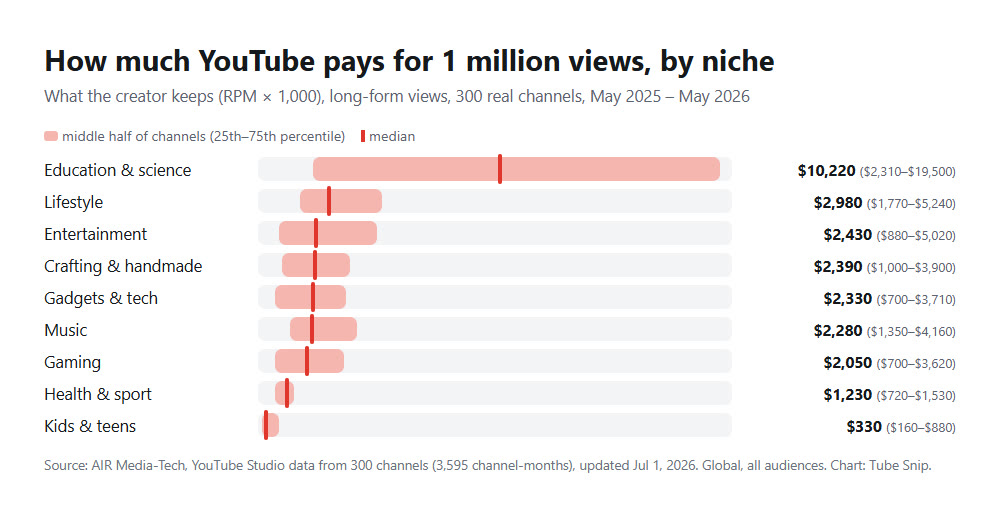
The best public data we found comes from AIR Media-Tech, which pulled YouTube Studio numbers from 300 channels (10,000 to 50 million subscribers) between May 2025 and May 2026. Here is what that means for 1 million long-form views:
| Niche | Median per 1M views | Middle half of channels |
|---|---|---|
| Education & science | $10,220 | $2,310 – $19,500 |
| Lifestyle | $2,980 | $1,770 – $5,240 |
| Entertainment | $2,430 | $880 – $5,020 |
| Gadgets & tech | $2,330 | $700 – $3,710 |
| Music | $2,280 | $1,350 – $4,160 |
| Gaming | $2,050 | $700 – $3,620 |
| Health & sport | $1,230 | $720 – $1,530 |
| Kids & teens | $330 | $160 – $880 |
Two things stand out. First, the gap inside a niche is often bigger than the gap between niches: two gaming channels can earn $700 and $3,620 for the same million views. Second, education isn't just a little better; it's in a different league, because advertisers pay more to reach people who are learning or researching a purchase.
How much does YouTube pay per view?
Per single view, the numbers get tiny:
| Views | At $2.30 RPM (median) |
|---|---|
| 1 view | about $0.0023 |
| 1,000 views | $2.30 |
| 10,000 views | $23 |
| 100,000 views | $230 |
| 1 million views | $2,300 |
| 10 million views | $23,000 |
| 100 million views | $230,000 |
So how much does YouTube pay for 1000 views (1k views)? About $2.30 at the median. And when people ask how much money per view on YouTube, the honest answer is "a fraction of a cent", and it only adds up at scale. How much does YouTube pay for 100k views? Around $230 at the median, with a realistic range from about $70 to $500 depending on niche.
Why the same views pay more (or less)
The same 300-channel study shows what moves RPM:
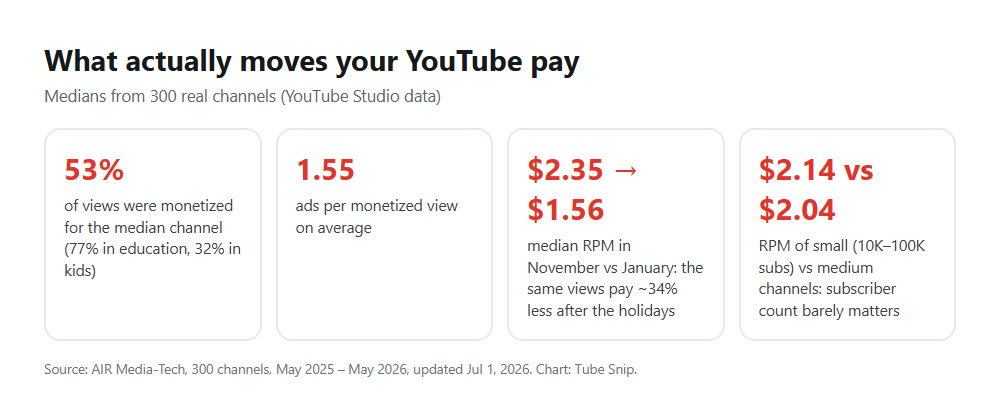
- Not every view has an ad. For the median channel, only 53% of views were monetized. Education reached 77%; kids' content only 32%.
- Ad load: a monetized view carried about 1.55 ads on average.
- Season: median RPM was $2.35 in November and $1.56 in January. Advertisers spend heavily before the holidays and pull back after, so the same million views pays about a third less in January.
- Audience location: viewers in countries where advertisers pay more raise your RPM; views from regions that barely monetize pull it down.
- Subscriber count barely matters: channels with 10K–100K subscribers had a median RPM of about $2.14, versus $2.04 for bigger channels.
How much does YouTube pay for 1 million subscribers?
Nothing directly. YouTube doesn't pay per subscriber. A channel with 1 million subscribers that rarely uploads can earn less than a 100K-subscriber channel that posts every week. Subscribers help you get views, and views with ads are what pay.
If you want to estimate a channel's income, use views, not subscribers. A channel getting 1 million long-form views per month at the median RPM earns about $2,300 per month from ads, or roughly $27,600 a year, before taxes.
How much does YouTube Shorts pay for 1 million views?
Much less than long-form. Shorts ads play between videos in the feed, not inside yours, and the money is pooled and split by views across every monetizing creator. If a Short uses licensed music, part of its share goes to cover the music first. Creators keep 45% of what's allocated to them.
There's no official Shorts RPM, and the 300-channel study we used doesn't report one. What's clear from how the pool works is that a million Shorts views earns a small fraction of a million long-form views.
A rule change makes this tighter: from February 1, 2027, a channel needs 10 million qualified Shorts views in the last 90 days to share in Shorts revenue at all. Channels below that stay in the Partner Program and keep earning from long-form videos.
YouTube monetization requirements (and the 2027 change)
YouTube only pays channels in the YouTube Partner Program (YPP). Today you need:
- 1,000 subscribers and 4,000 public watch hours in the last 12 months, or
- 1,000 subscribers and 10 million Shorts views in the last 90 days.
You also need to live where YPP is available, have no active Community Guidelines strikes, turn on 2-Step Verification and link an AdSense account.
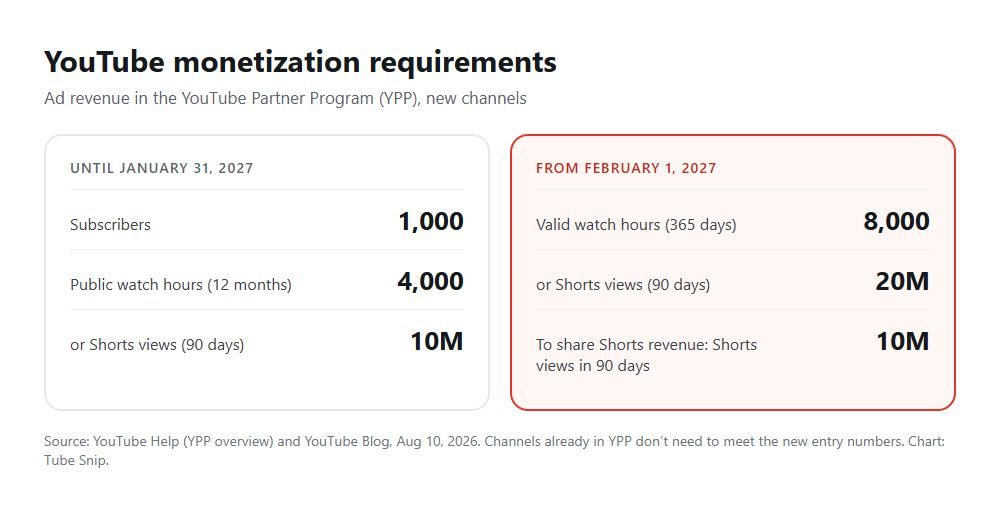
On August 10, 2026, YouTube announced new entry rules for channels applying from February 1, 2027:
- 8,000 valid watch hours in the last 365 days, or
- 20 million valid Shorts views in the last 90 days.
Channels already in YPP aren't affected. If you're close to today's thresholds, applying before February 2027 is much easier.
When does YouTube pay you?
YouTube pays monthly through AdSense for YouTube:
- Between the 7th and 12th, last month's earnings are finalized and added to your balance.
- On the 20th, your balance must have reached the payment threshold: $100 for a US dollar account.
- Between the 21st and 26th, Google issues the payment.
If you don't reach $100, the balance rolls over to the next month.
Taxes: if you live outside the US, Google withholds US tax on earnings from US viewers, between 0% and 30% depending on your country's tax treaty. If you don't submit tax info in AdSense, Google may withhold up to 24% of your total earnings. Talk to a tax professional about your own situation.
Our real example: 1,033 views, $0.00
Our channel posted a 21.3-second Short on October 16, 2026. In six days it reached 1,033 views with a 24-second average view, so people rewatched it.
YouTube paid us nothing. The channel isn't in the Partner Program yet, so those views don't earn ad revenue. Even if it were, a thousand Shorts views would be worth cents.
That's the part the "how much YouTube pays for 1 million views" headlines skip: before any money, there's the stretch of growing to the requirements, and during that time income usually comes from elsewhere, like sponsorships, affiliate links or your own product.
How to earn more per million views
- Pick a topic advertisers value. Education, finance and tech-buying content tend to have high RPM.
- Make videos 8 minutes or longer when the content needs it. Past 8 minutes you can place mid-roll ads.
- Use titles and tags people search for. Our YouTube title generator and tag generator give you options built around search terms.
- Add chapters. Our chapters generator turns a transcript into timestamps, which keeps viewers watching longer.
- Don't rely on ads alone. Memberships, Super Chat, affiliate links and sponsorships often beat AdSense for small channels.
The bottom line: 1 million long-form views pays around $2,300 at the median, anywhere from about $330 to over $10,000 depending on niche, much less for Shorts, and nothing until your channel is in the Partner Program.
Questions
How much does YouTube pay for 1 million views?
About $2,300 at the median RPM of 300 real channels ($2.30 per 1,000 views). By niche, medians range from $330 for kids content to $10,220 for education. Shorts pay much less.
How much does YouTube pay per view?
About $0.0023 per long-form view at the median, or $2.30 per 1,000 views. Not every view earns: the median channel monetized 53% of its views.
How much does YouTube pay for 100k views?
Around $230 at the median RPM. A realistic range is about $70 to $500 depending on niche and audience.
How much does YouTube pay for 1 million subscribers?
Nothing directly. YouTube pays a share of ad and Premium revenue based on views, not subscribers. Subscribers only matter because they bring views.
How much does YouTube Shorts pay for 1 million views?
Much less than long-form. Shorts revenue is pooled and split by views, and creators keep 45% of their share. From February 1, 2027, a channel needs 10 million Shorts views in 90 days to share in Shorts revenue.
Sources
- AIR Media-Tech: real RPM data from 300 channels (2026)
- YouTube Help: YouTube Partner Program overview and eligibility
- YouTube Help: Shorts monetization and the 45% revenue share
- YouTube Blog (Aug 10, 2026): YPP changes from February 2027
- AdSense Help: payment thresholds
- YouTube Help: US tax requirements for YouTube earnings